
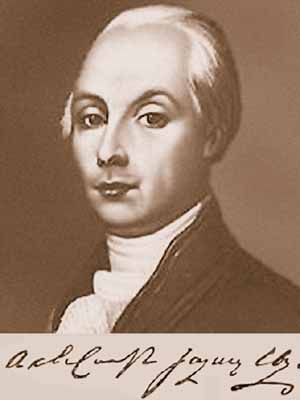
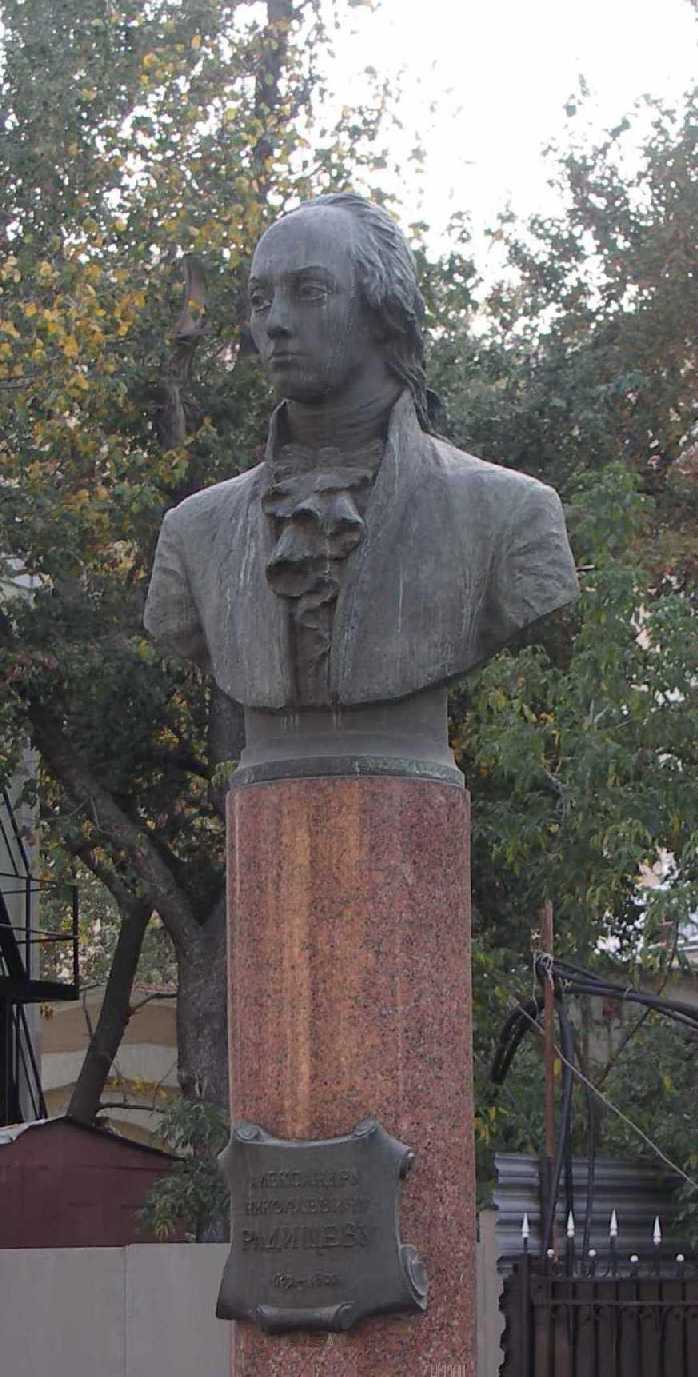
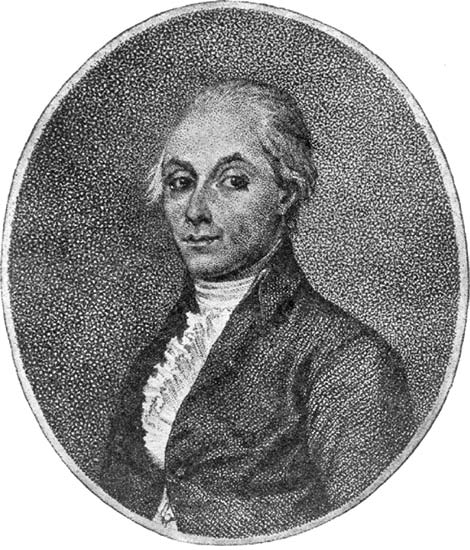
Alexander Radishchev
Russian author exiled for critiquing serfdom and autocracy.

Pansosh · CC0
Alexander Nikolayevich Radishchev was a Russian author and social critic who brought the tradition of radicalism in Russian literature to prominence with his 1790 work *Journey from St. Petersburg to Moscow*. His depiction of socio-economic conditions in Russia led to his arrest and exile under Catherine the Great.
- born
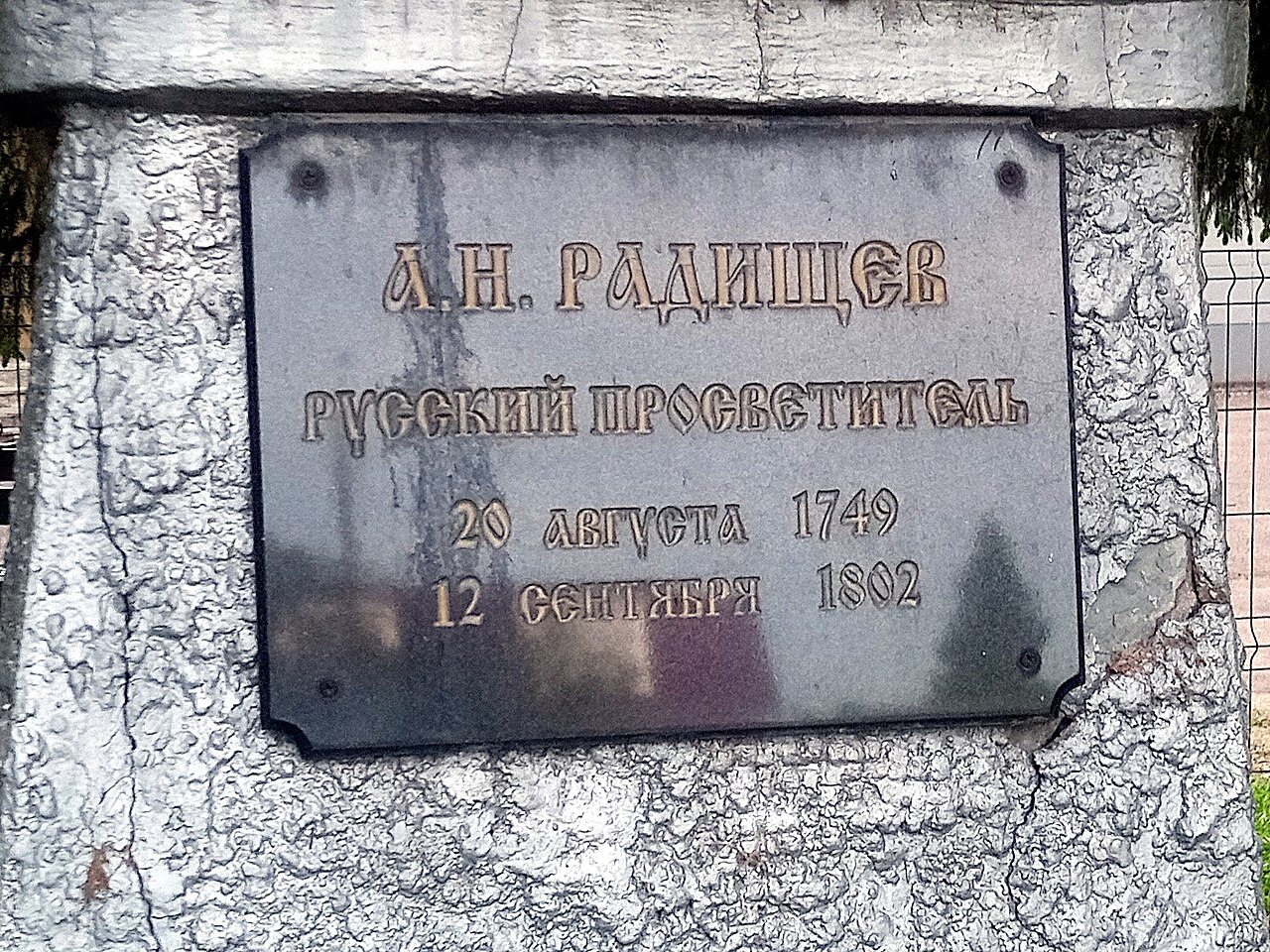
- 31 August [O.S. 20 August] 1749
- died
- 24 September [O.S. 12 September] 1802
- field
- Author, social critic
- nationality
- Russian
- known_for
- Journey from St. Petersburg to Moscow; radicalism in Russian literature
Lore & Background
Radishchev was born on an estate near Moscow into a minor noble family of Tatar descent. He studied at the University of Leipzig as one of a dozen young students sent abroad, where his exposure to Enlightenment philosophies influenced his views on Russian society. Upon return, he served as a Titular Councillor in Catherine's civil service while lauding revolutionaries like George Washington and the early French Revolution. His most famous work, *Journey from St. Petersburg to Moscow*, emulated the harsh style of Freemason Nicholas Ivanovich Novikov and criticized serfdom and autocratic limits on personal freedom.
Catherine the Great read the work, viewed it as Jacobin-style radicalism, and ordered copies confiscated and destroyed. Radishchev was arrested in 1790, condemned to death, but after publicly disowning his book, his sentence was commuted to exile in the Siberian town of Ilimsk. En route, he was treated as a common convict until Count Alexander Vorontsov secured more humane accommodations. He spent five years in Ilimsk with his second wife, serving as the local doctor and writing a philosophical treatise, *On Man, His Mortality, His Immortality*.
After Catherine's death in 1796, Tsar Paul recalled Radishchev and confined him to his estate. Under Alexander I, he briefly helped revise Russian law, but his tenure was short and unsuccessful. In 1802, despondent, he committed suicide by drinking poison, possibly after being rebuked by Count Zavadovsky for expressing radical ideas.
Reader's Guide
Radishchev's significance lies in his role as a pioneering radical voice in Russian literature, challenging the autocracy and serfdom at a time when such critiques were suppressed. His *Journey from St. Petersburg to Moscow* was banned until 1905, circulating only among radical groups and in translation. After the 1905 and 1917 revolutions, he was accepted into the radical canon and portrayed by Soviet authorities as a materialist and forefather of Bolshevism, despite discrepancies between his ideals and Soviet reality. His legacy includes influencing later writers like Alexander Pushkin, who attempted a sequel to Radishchev's work. Radishchev's views—favoring equality before the law, abolition of the Table of Ranks, trial by jury, religious toleration, freedom of the press, emancipation of serfs, and habeas corpus—reflected Enlightenment ideals, though he did not advocate bloody revolution, hoping instead for a reforming autocrat.
Did You Know?
- Radishchev was the grandfather of painter Alexey Bogolyubov.
- Only 17 of the original 650 copies of *Journey from St. Petersburg to Moscow* survived after Catherine the Great ordered them confiscated and destroyed.
- During his exile in Siberia, Radishchev served as the local doctor and saved several lives.
- He wrote a biography of Yermak, the Cossack conqueror of Siberia, while traveling to Ilimsk.
Noble Roots and Enlightenment Formation
Radishchev was born in 1749 on an estate near Moscow into a minor noble family of Tatar descent. His lineage traced back to defeated princes who, after the 1552 conquest of Kazan, entered Ivan the Terrible's service in exchange for baptism and were granted roughly twenty-two thousand acres of land, a holding their descendants expanded through generations of tsarist service. His father, Nicholas Afanasevich, was a prominent Moscow landowner known for treating his three thousand-plus serfs with unusual humanity. Young Alexander spent his first eight years in Verkhni Oblyazovo under a nurse and tutor before moving to Moscow, where he gained access to the newly founded Moscow University. In 1765, family connections secured him a page position in Catherine's court, which he viewed with deep suspicion, criticizing its contempt for Orthodox faith and its German orientation. Recognizing his exceptional academic promise, authorities selected him as one of a dozen young students sent abroad. At the University of Leipzig, he absorbed Enlightenment philosophies—natural law, the social contract—that would shape his lifelong critique of Russian autocracy and serfdom.
The Book That Dared to Speak
Radishchev's most consequential work, Journey from St. Petersburg to Moscow (1790), emerged from his deep admiration for Nicholas Ivanovich Novikov, a Russian Freemason whose publication The Drone delivered the first public critiques of the government, particularly regarding serfdom. Emulating Novikov's harsh, passionate satirical style, Radishchev produced a searing portrait of Russia's socio-economic conditions, targeting both the institution of serfdom and the constraints autocracy placed on personal freedom. Catherine the Great read the text and interpreted his reformist calls as Jacobin-style radicalism. She ordered all copies confiscated and destroyed; of the original 650 printed, only 17 survived until the work was reprinted in England half a century later. In 1790, Radishchev was arrested and sentenced to death. He humbly begged Catherine for forgiveness, publicly disowning his book, and his sentence was commuted to Siberian exile.
Five Years in the Frozen East
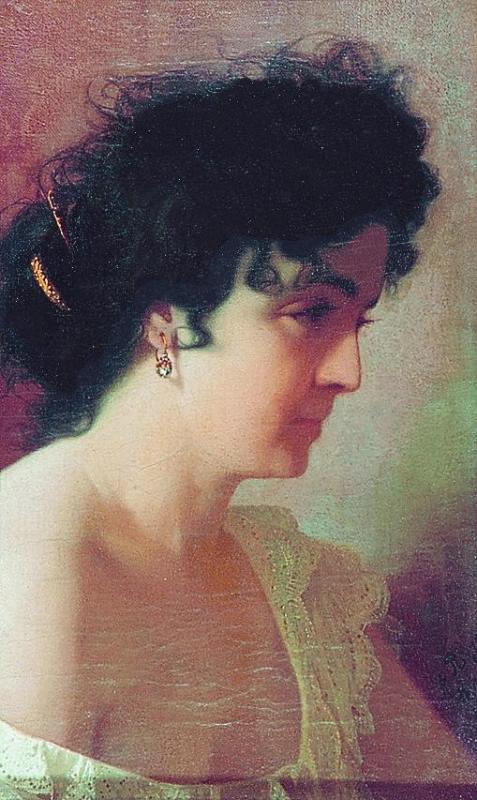
The journey to his Siberian destination was brutal. Shackled at the ankles and forced to endure the Russian cold, Radishchev was treated like a common convict. His friend Count Alexander Vorontsov, who held influence with Catherine, interceded to secure more humane accommodations, allowing Radishchev to return to Moscow to recover before resuming his journey with dignity. Beginning in October 1790, the two-year trek carried him through Yekaterinburg, Tobolsk, and Irkutsk before he reached Ilimsk in 1792. Along the way he began writing a biography of Yermak, the Cossack conqueror of Siberia, and pursued interests in geology and natural history. Settling in Ilimsk with his second wife, Elizabeth Vasilievna Rubanovsky, and their two children, Radishchev became the only educated man in the area and served as the local doctor, saving several lives. Over his five years there, he composed the long philosophical treatise On Man, His Mortality, His Immortality, which addresses belief in the afterlife, the nature of the soul, the ultimate redemption of sinners, and the faults of materialism—a work later revered as one of the few great Russian philosophical texts.
A Voice That Outlived Its Author
In his final Moscow years, Radishchev's apartment became a gathering place for literary circles that shared his radical views and mourned his death most outspokenly. Yet the autocracy managed to suppress Journey from St. Petersburg to Moscow from legal publication until 1905, during which period it circulated clandestinely among radical groups and was translated into several languages. Alexander Pushkin, sympathetic to Radishchev's passion and convictions, undertook to write a sequel to the inflammatory book but never finished it, facing early pressure from censors. Following the 1905 and 1917 revolutions, Radishchev was formally accepted into the radical canon and became widely read across Russia and Europe. Despite the obvious discrepancies between his Enlightenment ideals and Soviet reality, authorities nonetheless painted him as a materialist, an active fighter against autocratic tyranny, and a veritable forefather of Bolshevism. He was also the grandfather of the painter Alexey Bogolyubov.
Gallery
Frequently Asked Questions
Who is Alexander Radishchev?
Alexander Nikolayevich Radishchev (1749–1802) was a Russian author and social critic recognized for introducing radical political thought into the country's literary tradition. He is most closely associated with his searing critique of serfdom and autocratic governance.
What is Alexander Radishchev's most famous work?
His 1790 book *Journey from St. Petersburg to Moscow* is his defining text, a travel narrative that exposed the brutal realities of peasant life and the economic exploitation embedded in Russia's social order.
Why was Alexander Radishchev exiled?
Catherine the Great ordered his arrest and banishment after the book's publication because its unflinching depiction of serfdom and criticism of the autocracy were judged dangerously subversive to the existing power structure.
Why is Alexander Radishchev considered important in Russian literature?
He is generally regarded as the first major Russian writer to place radical political and social criticism at the center of a literary work, effectively opening the door for later social-realist and revolutionary authors. His example established that literature could serve as a vehicle for systemic critique rather than mere entertainment.
When was Alexander Radishchev born and when did he die?
He was born on 31 August 1749 (Old Style 20 August) and died on 24 September 1802 (Old Style 12 September), meaning his life spanned the reigns of Elizabeth, Peter III, Catherine the Great, and Paul I.
More in Russian And Soviet Writers 1-22
Spotted an error? Know more?
This is a living reference — every entry is fact-audited, and reader corrections feed straight into our audit queue. Suggest an edit · See this site's audit record